
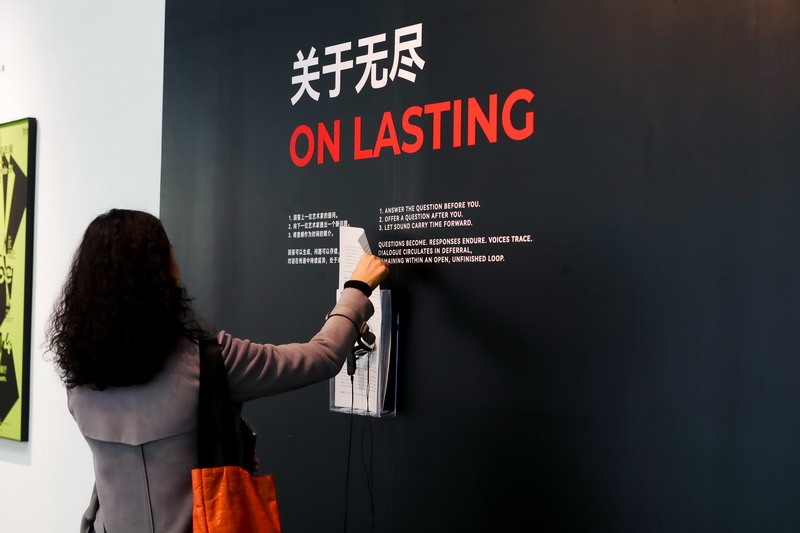
As an extension of the curatorial inquiries of Temporary Eternity: The 6th Shenzhen Biennale of Contemporary Art, “On Lasting”, an online Q&A relays of the participating artists is initiated. Centering on three dimensions—Becoming, Duration, and Trace—the project collectively probes the temporal dialectics of the “Temporary” and the “Eternal,” enriching the unique temporal experience of the city through artistic dialogue.
To break away from conventional interview formats, the project places the agency of questioning entirely in the artists’ hands. Following a relay-style exchange, each participant answers the previous question and asks the next one. This minimalist “one artist, one question” approach creates a self-contained, continuous chain of dialogue. The Q&A is presented within the exhibition and later extended through online platforms, expanding its reach to broader audiences.
Below are the Q&A relays from ——
the artists featured in “Quadrant I: Becoming”:
Yang Jian: Writing about one’s own work has always been a challenge. Could you share how you understand the relationship between an artwork and its description?
An Ning: Hello, Yang Jian. I feel that an artwork description is, to a certain extent, a supplement to the work itself. A description doesn’t have to remain in a purely functional or explanatory role—text can also function as artistic material. It can take a different direction from the work, or even be its opposite; it can contradict the work, or offer clues embedded as an undercurrent. One of my works, Anthropologismus Trap (2022), consists of three contradictory elements—the form, the title, and the description—where the textual clues can entirely overturn the visual form. So to me, an artwork description is never a single-purpose attachment; it has a significant impact on the integrity of the work. There is always something worth savoring in that tension.
An Ning: Hello, Qingtai. I came across an interview where you mentioned your “part-time work”. I’d like to ask: within that part-time setting, does the identity of “artist” function as a fallback—one that softens the pressures of the job through a more elevated, almost sympathetic kind of understanding?
Hu Qingtai: That’s an excellent question. But I don’t really view the two as being in opposition, so I don’t see part-time work as a fallback from artistic creation. To me, they’re interconnected, each sparking the other and allowing one stage to build upon the next—there’s even a kind of sequential causality, where what comes first often makes what follows possible. At the heart of it, everything we do in life ultimately is about understanding and expressing our relationship to the world and to ourselves. So, to return to your question, part-time work can also be seen as an act of creation—in its own way, it is part of the creative process; while art becomes the outcome, or the answer, that grows from it.
Hu Qingtai: Hello, Annan. As a new media artist, how do you understand the concept of “new media”? And since you work both as an artist and a designer, do the two roles ever conflict? How do you balance them?
Shao Annan: Thank you, Qingtai. I appreciate your question. I think “new media” is always a relative concept. For instance, the mediums I work with—3D animation and mixed-media installations—are by now extremely familiar to me, almost like a native language. So personally, they don’t feel “new”. But for the public, new media may still be perceived as a stimulating mode of artistic communication. In my understanding, new media is a fluid state—always moving, always exploring. As for navigating the dual roles of artist and designer, inevitably, there are conflicts in how time is allocated. In my current practice, it’s roughly half-and-half, though at times I have to turn down some design projects in order to protect enough creative time. I hope this allows me to maintain a reasonably balanced state.
Shao Annan: Does your sense of time affect your creative process? If so, in what ways does it show?
Wang Yezi: Subjectively speaking, I used to believe that my sense of time didn’t affect my work. But thinking further about your question, I realized that time often appears in my works as nodes. For instance, in my video piece ART presented in this exhibition, time disperses through sound—sliced, accelerated, and sequenced in nodes.
Wang Yezi: Fictional constructs often appear in your works. I’m curious how you define “the real” and “the virtual,” and where you feel the boundary between them lies.
Wang Yunchen: In my practice, there is no boundary between the virtual and the real—they merge into one. The so-called “virtual” is merely a technical method. I integrate virtual techniques with the tactile brushwork of physical imagery. In terms of content, I do not think the two are separate; but technically speaking, the viewer can still tell them apart through physical, perceptible cues.
Wang Yunchen: My question for Yang Jian is about the notion of “interesting” you’ve mentioned in relation to your work. Could you elaborate on what you mean by that?
Yang Jian: When I first heard Yunchen’s question, I was actually puzzled—I couldn’t recall when I had said this. But as I mentioned, I looked it up and found that it came from an interview in 2016. I don’t really use the term as often anymore. Back then, when I used the term “interesting,” it wasn’t the result of rigorous thinking. I simply used it to describe any artwork I considered good. This “interesting” more or less encompassed every positive appraisal across time and culture—much like certain strands of Chinese philosophy or Japanese aesthetics: seemingly empty, yet somehow fills an entire room.
Quadrant II: Duration— Artist Q&A Relay
Fang Yang: I’ve noticed that you use a large number of circles in your work to create or fill objects. Is there any particular significance behind your choice of this shape?
Hu Yuanyuan: I search for the meaning and logic behind things, striving to uncover and wait for traces of forms to emerge amid pauses and difficulties—almost as if I’m putting them through a kind of test and training. In this simplified order, I aim to keep my voice as quiet as possible.
Hu Yuanyuan: How do you understand the dialectical relationship between local materials and forms in terms of recording, restoration, construction, temporary preservation, and eventual disappearance? Among their in-situ evolutions within specific processes, which aspects hold significance for reflection and validation? At the same time, how do geographical modes of existence—such as objects, natural engineering—interact with human migration and movement to give rise to a particular narrative expression?
Huang Jiayan: My choices of materials and forms stem from my intuitive sense of the local environment. As for narrative, there’s no specific content—rather, it’s more a synthesis of abstract visual language and an accumulation of sensory experiences. In terms of my working approach, I draw inspiration from literature, aiming to express my feelings about this land through creative methods of contemporary art. The way my work is presented is the result of my careful selection and refinement, and it’s all about the people who live on this land.
Huang Jiayan: (In your work,) do the choices of container shapes, the beads connected in series, and certain lines metaphorically represent a kind of connection? And could their quantities and forms be adjusted?
Huang Peishan: Vases are a very typical type of container. I choose vases because they’re always used to hold something—something beautiful. They serve to preserve and carry forward these beautiful things, and in themselves, they’re incredibly intriguing. Yet in my work, I take the shape of vases—their container form—and cut it out as a vector graphic, using these shapes to hold onto memories from my travels. It’s almost as if I’m continuing those memories in some way. The strings of beads and chains are just like raindrops or the chains on a door. They link everything together, and their forms can be adjusted freely—adapted to suit the specific context and venue of each exhibition. In this way, they embody a sense of fluidity, much like our memories.
Huang Peishan: If a fountain maintains its form through continuous falling and sustains through ceaseless motion, then is this eternity, composed of endlessly repeating nows, a temporality that is incessantly replaced by fleeting moments, or rather, a structure that treats change itself as eternal?
Li Gang: I think your question is also your answer. I once observed the top of a fountain—a momentary pause created when the upward and downward movements cancel each other out, a fleeting instant akin to the brief glow of a bonfire. On a certain level, both fountains and bonfires embody this beauty of an ephemeral moment.
Li Gang: Hello, Ms. Li Yafan. I’m delighted to have the opportunity to ask you a question—it’s also a chance for us to exchange ideas about our creative practices. My question is this: As an artist and creator, how do you view the concept of inspiration? Or rather, in your art, in what specific way does inspiration manifest itself? What kind of process do you go through to transform inspiration into your creations? Or how do you perceive the relationship between inspiration and art? Thank you.
Li Yafan: Hello, too, Mr. Li Gang. My name is Li Yafan. It’s my pleasure to talk with you. For me, inspiration is never a sudden, unexpected gift—it’s always sparked by a particular opportunity. When enough raw material has accumulated, all it takes is one single trigger, and those scattered impressions can quickly coalesce into a concrete, actionable creative core idea. Such opportunities often come frequently—and yet, they’re remarkably accidental. For me, it might be an unexpected emotional surge; it could also be a fleeting memory that flashes through my mind when I’m standing at a high vantage point overlooking the city; or perhaps it’s the deep inner resonance I feel when I empathize with someone else’s story. Each of these moments sets off profound reflections on the world around me. Combined with the rich accumulation of my own personal experiences, this gives my inspiration both warmth and weight. Most of the inspiration behind my work stems from my observations of cities’ rapid development—watching as old buildings quietly disappear while new landmarks rise up, all of which become crucial components of my creative reservoir. Once these reflections are awakened by a specific opportunity, my work ceases to be merely a personal expression of emotion. Instead, it begins to touch upon broader themes of our times, resonating deeply with a wider audience. For young creators like me, the key lies in sharpening our senses, making our emotions more nuanced, and deepening our understanding. By continually honing our artistic techniques and constantly filling ourselves with diverse experiences, we transform ourselves into vessels brimming with rich material. And when we do that, the seeds of inspiration will naturally find their way into the everyday moments of our lives.
Li Yafan: Hello, Ms. Liu Fujie. I’m Li Yafan, and it’s great to learn from you. I’m particularly impressed by your ability to transform the chaotic visions that automatically emerge in your mind into spatial narratives with blurred boundaries—narratives that not only preserve your instinctive, personal perceptions but also enable viewers to connect with the underlying emotions. I’d like to ask you: When young artists like us seek to turn our deeply personal inner experiences into narratives, how should we find the right entry point? How can we maintain the purity of our self-expression while avoiding the risk of our work becoming too niche or overly interpreted, and instead ensure that it resonates effectively with a broader audience?
Liu Fujie: Hello, Yafan, thank you for your thoughtful question. Regarding the idea that transforming personal experiences and emotions into language in creative work can open up broader perspectives, what comes to mind is the importance of delving more deeply into what our own experiences truly are and how we understand them. By doing so, we may gradually build a more complete artistic world of our own. I’ve noticed that in your paintings, you’re using abstract language—which already helps avoid overly specific interpretations, thereby allowing your works to resonate with viewers on multiple levels and offer greater possibilities. As for how audiences interpret your work, I’ve always remained open-minded in my own practice. Still, I try my best to convey these ideas through relatively clear language or text. Of course, words can never fully replace visual language. I hope these thoughts have helped answer your questions.
Liu Fujie: Hello, Ou Jin. I’m Liu Fujie. In my own practice, whether it’s the technologies or techniques I use, the experience of touch and feel has always occupied a relatively important position. So, I’d like to ask you: In your creative approach, what do “algorithms,” “instructions,” and “the body” each signify?
Ou Jin: Hello, Liu Fujie. In my work, “algorithms” serve as the logical framework underlying the idea that everything in the universe is reducible to numbers—a key that dissects natural laws and touches upon the very essence of the world, transforming abstract order into a visually tangible foundation. “Instructions,” on the other hand, represent my own creative interventions serving as a bridge between algorithmic rationality and artistic intent. They’re not merely about controlling machines; rather, they’re a dialogue between human and technology, enabling cold lines of code to give rise to rich, imaginative creations imbued with subjective will. The “body” acts as the sensory anchor of creation—the ultimate recipient of both “algorithms” and “instructions.” The texture of materials felt beneath our fingertips, the intuition with which our eyes perceive patterns—all these elements infuse rational mathematical logic with a palpable warmth and soul, forging a profound connection among the three. Ultimately, “algorithms” define our worldview; “instructions” provide the methodology; and the “body” serves as the perceiver.
Ou Jin: Hello, Peng Du, this is Ou Jin speaking. Your work has gradually evolved from early, personalized visions of the female body to exploring the relationship between societal digitization and individual perception. I feel that this progression—from the personal to the social—is a very natural transition. I’d like to ask: How do you approach the relationship between personal emotions and social issues in your creative process? Do you tend to focus more on the sublimation of your own personal feelings, or do you instead amplify broader social commonalities in your work?
Peng Du: Hello, Ou Jin—great to receive such a thoughtful and well-intentioned question from you. For me, personal emotions and social issues are not two opposing realms; rather, they’re in a continuously interpenetrating relationship. In my earlier works, my approach did indeed tend toward metaphorical explorations rooted in the individual female experience, because at that time I was more focused on the flow of emotions—the way they could be perceived and expressed through bodily narratives. But as my personal experiences grew and my creative practice advanced, I began to realize that many of what I’d initially considered purely personal feelings were actually deeply embedded within larger social structures. So, when I started paying attention to data-driven systems and social mechanisms, it was not about abandoning my personal feelings; instead, it was about trying to understand how these emotions are quantified, disciplined, and shaped—and how they evolve within algorithmic environments—in the context of broader social issues. In this process, my own emotions no longer serve merely as a starting point for narration; rather, they’ve become more like sensory devices—tools for testing how social structures operate on the individual level. Thus, I don’t deliberately choose between deepening personal emotions and amplifying social commonalities. What interests me more is the tension between the two: how personal experiences can, to a greater extent, reach and resonate with broader social commonalities, and how social issues, in turn, can be re-embodied through specific personal perceptions. My creative work moves back and forth between these two dimensions, rather than shifting from one to the other. I hope my response has adequately addressed your question. Thanks.
Peng Du: Hello, Mr. Shen. Your works often ignite immediate and strong intuitive chemistry. In today’s viewing environment, artworks often get quickly captured, circulated, and interpreted. Have you ever worried about your work being disseminated in fragments? If so, what kind of viewing context would you like to supplement?
Shen Shaomin: Thank you for the question, Peng Du. I think partial interpretations are also a kind of interpretation. I’m not worried about that. I believe artists should question everything, in one way or another, and partial readings are also responses to the issues I address. So I’m not concerned about such one-sided interpretations.
Shen Shaomin: In your opinion, in making art, which is more important—concept or technique? How do you balance and make your decision?
Song Ziwei: For me, concept is definitely more important than technique. Conceptual works can exist without physical objects, which is very interesting. They depend more on the narratives behind them and observations of the world. In fact, they are intangible; they can take on any material and be presented in any form. I like this kind of plasticity and fluidity.
Song Ziwei: When we look at works with ready-mades as material, what exactly are we looking at? Is there a threshold in this kind of viewing—something only accessible through education?
Sun Lanhe: Hello, Ziwei, thank you for your question. This is a core issue regarding the use of ready-mades. I’ll focus on the latter part of your question, and the first part will be answered along the way. I believe that viewing works with ready-mades does require a certain threshold and education. This is because such works involve a process of translation carried out by the artist, where a ready-made might be translated into a unique artistic perspective, a philosophical reflection on the object, or a certain symbolic metaphor. Audiences also differ—there are generally two types: general audiences and professional audiences. Professional audiences include artists, curators, critics, galleries, museums, etc., who have, to some extent, already been educated. When general audiences become interested in ready-mades and begin to ask why they are considered art, they may already be preparing to cross that threshold. So when viewing artworks that use ready-mades, one is looking at the translation in artistic language, rather than at ordinary objects. Thank you.
Sun Lanhe: Hello, Danbo. I’m Sun Lanhe, and I’m very lucky to ask you a question. My understanding of abstract painting largely comes from Clement Greenberg’s idea of “pure painting,” emphasizing flatness and purity, independent of any subject’s movement through time. But in your work, I see fragments floating in an ambiguous space, like a captured moment. I’m not sure whether time functions as a medium in your practice, or whether you consider time to be real and reliable. Thank you.
Wu Danbo: Thank you, Lanhe. This is a very meaningful and thought-provoking question. In my creative process, time indeed exists as an important medium of qualitative change. Although time may not be truly reliable—Einstein also said that the distinction between past, present, and future is merely a stubbornly persistent illusion, in my practice, I do experience this illusion through the changes brought by time, and my works are the result of that experience. Thank you.
Wu Danbo: Hello, Wu Dandan. I’m happy about this interesting arrangement. Now it’s Wu Danbo’s turn to ask Wu Dandan a question. Our names are very similar, and we are both from the post-80s generation. I’ve also seen your work, which juxtaposes traditional embroidery with modern photography. My question is: how do you interpret the embroidery in your work—as a symbol or a metaphor?
Wu Dandan: Hello, Wu Danbo. Thank you for your question. What a coincidence that our names are so similar. For me, in the work Refracted Body, embroidery leans more toward being metaphorical. It is a metaphor for time and labor, and for everything people give in the pursuit of good or a sense of eternity.
Wu Dandan: Hello, Xia Cheng’an and Villo. My question is: in Soy Sauce Bar has Closed, there is the smell and taste from your childhood, and life experiences that are gradually disappearing. When you turn them into this video of performance and storytelling, how do you view the change in your identity? For example, from your childhood selves to the artists living in a technological and networked environment today—what does this shift mean for your practice? Thank you.
Xia Cheng’an: Hello, Wu Dandan. In writing scripts for our video works, we often use personification. We let an object become the protagonist and narrate in a third-person voice. This transforms the narrative into a novel kind of self-expression, while allowing the text to incorporate both personal memory and researched story materials, making it a semi-fictional narrative that carries the collective memory of a larger group. In Soy Sauce Bar has Closed, we let a bottle of soy sauce complain that they lost their job because people today eat too blandly. The main purpose is to reflect on how numb people’s senses have become today and attempt to reawaken sensory feelings by recalling the strong flavor of soy sauce from childhood.
Xia Cheng’an: Hello, Xie Lisi. I’m Xia Cheng’an. I’ve noticed that you’ve been exploring the flat-style depictions of artificial objects for quite a long time. My question is: as time and technology advance, what changes have occurred in your painting subjects and meaning interpretation?
Xie Lisi: Hello, Xia Cheng’an. Thank you for your attention to my long-term exploration of flat-style depictions of artificial objects. The “flatness” in my work is more spiritual and social rather than mere visual—standardized urban landscapes, assembly-line daily life, homogenized aesthetics, and regulated routines. As time and technology advance, the artificial objects I paint are no longer just landscapes or objects themselves, but metaphors for the condition of contemporary people—conforming, efficient, harmless, yet also lonely, hollow, and lacking warmth. In my work, I continue to investigate and express, trying to leave traces of emotional silence and poetic lining within extremely constrained images and place the most genuine inner states of modern individuals into “the world of no one”.
Xie Lisi: Your work sculpts a self-secluded yet infinitely extended field, the imagery renders a sense of isolation and estrangement. Does it stem from personal experience or from your observations of social relationships in modern society? And how do you precisely translate that into visual language in your practice?
Yao Zhiyan: Hello, Xie Lisi. Thank you for your question. My work is indeed related to my personal experience. More than ten years ago, I went through two life-and-death incidents—once suffering from depression, and once from a serious illness. So in my work, there is no despair or complaint about life. Instead, I present my experiences and my observations of society through humor and solitude. This work originates from my personal experience and feelings, so it still implies a tinge of sentimentality. But I don’t overly vent it. I remain optimistic about life and continue to enjoy it. Despite past experiences, I still want to convey a sense of humor, estrangement, and absurdity—such is the way I chose to face society and hope to remain optimistic. This optimism isn’t about praising, but about living life to the fullest and doing what I love. Thank you for your question. I’m very happy to see it.
Yao Zhiyan: I’d like to ask Zhang Minghui: contemporary art is neither defined by a specific style nor tied to a particular medium, yet it is often labeled with avant-garde concepts. What determines its “contemporaneity”—distinguishing it from traditional and modern art—is it the context of creation, the conceptual core, or its social function? Thank you.
Zhang Minghui: Thank you Yao Zhiyan for your question. My answer is that I cannot reduce it to just one of those aspects. The “contemporaneity” of art is merely a label actively assigned by humans. In the artist’s process of production, both the context of creation and the underlying ideas are embedded. This process—and its outcomes, regardless of meaning, type, or method, whether intentional or unconscious—will subtly manifest in social function. This is my answer, thank you.
Zhang Minghui: I’ve seen a series of works by Mr. Fang Yang, and I find a whimsical contrast between the presentation of the works and their titles—I think it is very straightforward. I’m curious: if you could use one keyword to describe the strongest point of connection between your work and yourself, what would it be?
Fang Yang: Hello, Minghui. Actually, the contrast between my titles and my work contents is not as strong as it may seem. This may be because what’s shown online are often flat images or still frames. In fact, my titles come from the content, subjects, and sources of the images. After a work is completed, I extract short phrases or words, break them apart, and recombine them into a concise title. It has to be colloquial—like an inner monologue, very random, an incomplete sentence surfacing when you’re least attentive. That doesn’t mean I don’t interpret it as text; I see it as part of the image composition, just like blocks of clay in this piece of flat work. These short phrases, or titles, and these images function like pixels, ultimately filling in the overall composition. Therefore, I don’t think they are meant to provide a clear meaning; I think they are more about a sculpted vibe. If I had to choose one word to describe my point of connection with it, I would choose “spelling” , similar to the title of my previous solo exhibition. Thank you.
Quadrant III: Trace — Artist Q&A Relay
Cheng Xianghan: Hello, Mr. Jiang Bo. I’d like to ask you a question related to this section. In your practice, do these traces function more as an expressive language that you actively employ, or do they emerge gradually through your interaction with materials? How do you understand the idea of “leaving traces”? Thank you.
Jiang Bo: Hello, Xianghan. Thank you for your question. My works all come out of the ongoing frictions and encounters within my daily practice. “Traces” are impermanent, but they are also inevitable.
Jiang Bo: Li Ji, may I ask how many large trees have you photographed in total?
Li Ji: I’ve photographed around sixty large trees. If we’re talking about shooting more broadly, the number would be higher, but in terms of works that feel complete and have been fully realized, it’s roughly sixty.
Li Ji: I have a question for the artist Luan Chongyang. I’m very interested in your approach to spatial practice. There’s a feeling in your work that reminds me of watching a boxing match as an observer—you’re there, but always at a certain distance. So I’m curious: do you enjoy boxing? Have you practiced it yourself? And also, do you play games? There’s a certain atmosphere in your images that feels almost game-like. I wonder if you’re bringing together elements of gameplay with the textures of lived experience or spectatorship. Thank you.
Luan Chongyang: Thank you, Li Ji, for the question. I do enjoy boxing very much, and I’ve continued training up to now. In recent years, it has become an important part of my life, and many of my works take boxing as a subject. As for games, I have indeed drawn some inspiration from them. I find that many early pixel art and flat graphics in games have a very interesting way of constructing forms, which can be quite inspiring. At the same time, my approach to form is also influenced by animation and murals.
Luan Chongyang: Hello, Mao Maoyu. I understand that this body of your work revolves around the theme of a wandering circus. Circuses seem to have largely disappeared from everyday life. What led you to work with this theme? Is it connected to your personal experiences growing up?
Mao Maoyu: The circus is something I feel deeply attached to—it runs through almost all of my work. I imagine it as a tent rising late at night, glowing from within, just as a revelry is about to begin. It’s mysterious and fleeting, yet also feels very familiar to me. I don’t know exactly when it appeared, but you sense that it exists somewhere in your memory—perhaps as a kind of ancient, shared experience, or as something from childhood, like inventing games and playing them with friends. In a way, those moments may already have been a kind of miniature circus. I’ve always felt that the circus is neither nostalgic nor unfamiliar. It is a kind of beautiful structure—something that is at once installation-like, temporary, mobile, and nomadic. It also holds music and overlaps closely with many of the things I care about.
Mao Maoyu: I’d like to pass on a question about naming. What does “naming” really mean? When a work is named again and again—continually reinterpreted, written into wall texts, recalled in memory, incorporated into archives and critical writing—what do these names come to signify? What happens through this repetition? Do you see naming as a form of continuation, or of transmission? Or is it perhaps an inevitable, even somewhat tedious, yet very real kind of energy in motion? I’m curious how you think about this: what kinds of subtle, enduring changes naming might bring, and how you coexist with them.
Miao Hanwen: Thank you, Ms. Mao, for this question—it’s a very interesting one. You mentioned whether naming might be a form of continuation or transmission, and also described it as a kind of “energy in motion,” which I think is a very apt way of putting it. To me, this flow of energy has a lot to do with the artist’s own thought process. At different moments in time, when you return to a work, your feelings about it can shift. That shift itself may be understood as a kind of energy flow—an emotional field, an internal fluctuation within the artist. I really like the way you described it as “subtle and enduring change.” I feel that very strongly in my own work. A year after completing a piece, my understanding of its title might already be different. Two years later, it may shift again. These changes are tied to my state of mind at the time, or to my sense of presence within the act of creation. Because both the artist and the artwork are constantly changing—they’re not fixed, like a mathematical equation where one is always one, and two is always two. So I think change is entirely natural, and in fact, it continues to exist alongside the artist. It’s exactly the kind of subtle, long-lasting transformation you mentioned. But it follows a certain trajectory. It’s not random or chaotic.
Miao Hanwen: Hello, Mr. Shen. My question is about the relationship between artistic practice and the city it takes place in. Shenzhen is known for its fast pace and diversity. What kinds of unique inspirations or points of contact do you feel it offers your work? And how are these elements translated into the specific forms or symbols within your practice? Also, as a young professional artist, I understand that working in Shenzhen can be challenging. How do you navigate the tension between its commercial environment and the desire for artistic purity? Thank you.
Shen Zhoulai: Hello, Mr. Miao. In recent years, my work hasn’t engaged very directly with the city. My studio is in Wutong Mountain. I feel as though I’m in Shenzhen, yet also quite distant from it. My practice draws more from nature, poetry, music, and dreams. I look for something universal within the personal, and express it through my work. As for the relationship between commercialization and artistic purity, I think it’s difficult to truly balance the two. It ultimately comes down to making choices. For now, I’ve chosen to prioritize purity, and my work hasn’t entered the commercial sphere.
Shen Zhoulai: As an artist, what is it that draws you to contemporary art? And how do you think the development of AI might influence your practice?
Wen Zhenfei: As an artist, the first thing I consider is materials. Working in oil painting, that naturally begins with the materials and tools of the medium, as well as the exploration of painterly language—how expression is constructed through painting. I think this is a fundamental question for all artists. Secondly, it’s about developing a deeper understanding of society and of life. These reflections ideally become the conceptual foundation that supports the work. As for AI, I see its emergence as something that can propel painting forward. If we look back in history, the invention of photography dealt a blow to Western realist painting, but it also opened up new possibilities, leading to movements like Impressionism and Post-Impressionism. In other words, after the camera appeared, Western art entered a state of great diversity. In that sense, I believe the emergence of AI will also, in different ways, contribute to the continued development of art.
Wen Zhenfei: May I ask, how do you integrate traditional artistic concepts into your current explorations and experiments with new media, as well as into your modes of expression?
Yao Mingfeng: For me, traditional artistic concepts function more as a way of thinking and working. In my practice, I’m particularly interested in how traditional frameworks approach relationships—between time and space, and between the individual and the world. This also carries through into my work. In some pieces, I don’t seek to exert full control. I allow things to unfold naturally, letting them grow on their own through algorithms or computational processes. New media, for me, is a tool. Traditional concepts, on the other hand, are more like an underlying structure. They determine how a work comes into being and how it evolves.
Yao Mingfeng: Hello, Kanbao. My question is: in your practice, how does a sense of locality enter your use of materials, space, and narrative? And how does it ultimately shape the final outcome of your work?
Yin Kanbao: Hello, Mingfeng. Let me try to respond to that. In my work, locality is something that exists over a long period of time. And I think, as an artist, it’s important to place your body within a field of presence—to truly be there. Over time, through reflection and gradual growth, it becomes something like a plant: it grows naturally toward the light, taking on a form of its own. Whether that form is intentional or not, I can’t fully predict. But in the end, it feeds back into the work, forming a kind of expression that relates both to the space and to my own life. As this process of growth slowly takes shape, it begins to merge into my work, becoming what it naturally is meant to become.
Yin Kanbao: Hello, Yu Qian. I’m Kanbao. I have just one question for you: in your life, what does art-making mean? Thank you.
Yu Qian: Hello, Kanbao. Let me try to answer your question. I feel that art, in my life, can be divided into three stages. In the first stage, when I was just beginning to study art, it felt like a belief system for me. In the second stage, it became a process of self-growth and a way of exploring the depth of life. And now, art has returned to everyday life. It has shed all of its aura. Even my perception of people who make art has lost some of that mystique. At this point, art feels like just a part of my life—it’s as natural as breathing.
Yu Qian: Hello, Yuan Xiao—I’m Yu Qian. My question for you is: how did you begin making art? And is art important in your life?
Yuan Xiao: Thank you for your question, Yu Qian. I’ll start with the second part—is art important to me? I would say it’s extremely important. It records my life, my emotions, my feelings, and the way I see the world. As for how I began making art, it’s probably related to my academic background. I studied traditional Chinese painting as an undergraduate, and later went to the UK to study contemporary art. Through that process, I realized that making art could expand my boundaries. I became interested in areas like technical design and production; it also opened up my interest in emotions and inner healing, as well as in documenting my relationship with the external world. Art, for me, is about finding an appropriate position from which to express ideas and perspectives. It was through that realization that I began making art.
Yuan Xiao: Hello, Zhao Xiaodan. Looking at your paintings, I’d like to ask a question about the relationship between the individual and the collective. In a social context where consumerism is prevalent, aesthetic preferences are becoming homogenized, and individuals are increasingly alienated, how can the individual still be seen?
Zhao Xiaodan: Hello. As you mentioned, in this context of consumerism, homogenization, and alienation, if an individual artist wants to be seen, I think they need to move in the opposite direction. In terms of traditional visual art practices, it’s still about finding an irreducible sense of subjectivity—something that cannot be replaced—rather than simply catering to the logic of visibility or trends. One aspect is to preserve traces of the human. This doesn’t necessarily mean personal narrative, but could also be forms of shared emotional resonance. Another is to retain the traces of labor within the process of making; that, too, carries a personal touch. Overall, I think genuine pain and true singularity are rare within this current tide of sameness.
Zhao Xiaodan: Hello, Cheng Xianghan. My question is: in a context where AI technologies have fully permeated all aspects of our lives—including the field of art—do you think the core criteria for evaluating truly good artworks will change in the future? For example, might the criteria shift from visible technical mastery toward the irreplaceability of human experience? I’d love to hear your thoughts. Thank you.
Cheng Xianghan: Hello, Ms. Zhao. Personally, I think that standards for judging art are always in flux. They shift across different historical contexts, and even from one individual to another. With AI technology becoming increasingly sophisticated, many artists have already begun incorporating it into their practice. For me, I still feel some resistance toward AI-generated writing, but I tend to see AI as a new tool or pathway for expression. What matters most is how the artist chooses to use it. As for the idea of human irreplaceability, I tend to understand it as a distinct human visual language, as well as a mode of thinking in the creative process that embraces uncertainty. It’s this kind of unpredictable judgment and generative process that I believe remains irreplaceable. Thank you.
|
TEL:0755-26655881 |
EMAIL:info@shangqiart.cn |
|